


SEO is no longer just about keywords and backlinks — it’s about intelligence. Artificial Intelligence (AI) has redefined how content is created, optimized, and ranked. Whether you’re a marketer, content creator, or SEO strategist, learning how to do AI SEO is now essential for staying relevant in search visibility and traffic growth.
Let’s break down the core SEO practices, SEO elements, and key topics you should master in 2025.
1. What Is AI SEO?
SEO (Artificial Intelligence Search Engine Optimization) refers to using AI-powered tools, algorithms, and automation to analyze search data, predict trends, and optimize content for better rankings.
Unlike traditional SEO, AI SEO combines machine learning, natural language processing (NLP), and predictive analytics to help websites perform smarter — not harder.
For example:
- AI can predict which keywords will trend in the next 30 days.
- It can analyze user intent from massive data patterns.
- It can auto-optimize content for semantic search and readability.
In short, AI SEO transforms guesswork into data-driven precision.
2. How to Do AI SEO – Step-by-Step Practical Approach
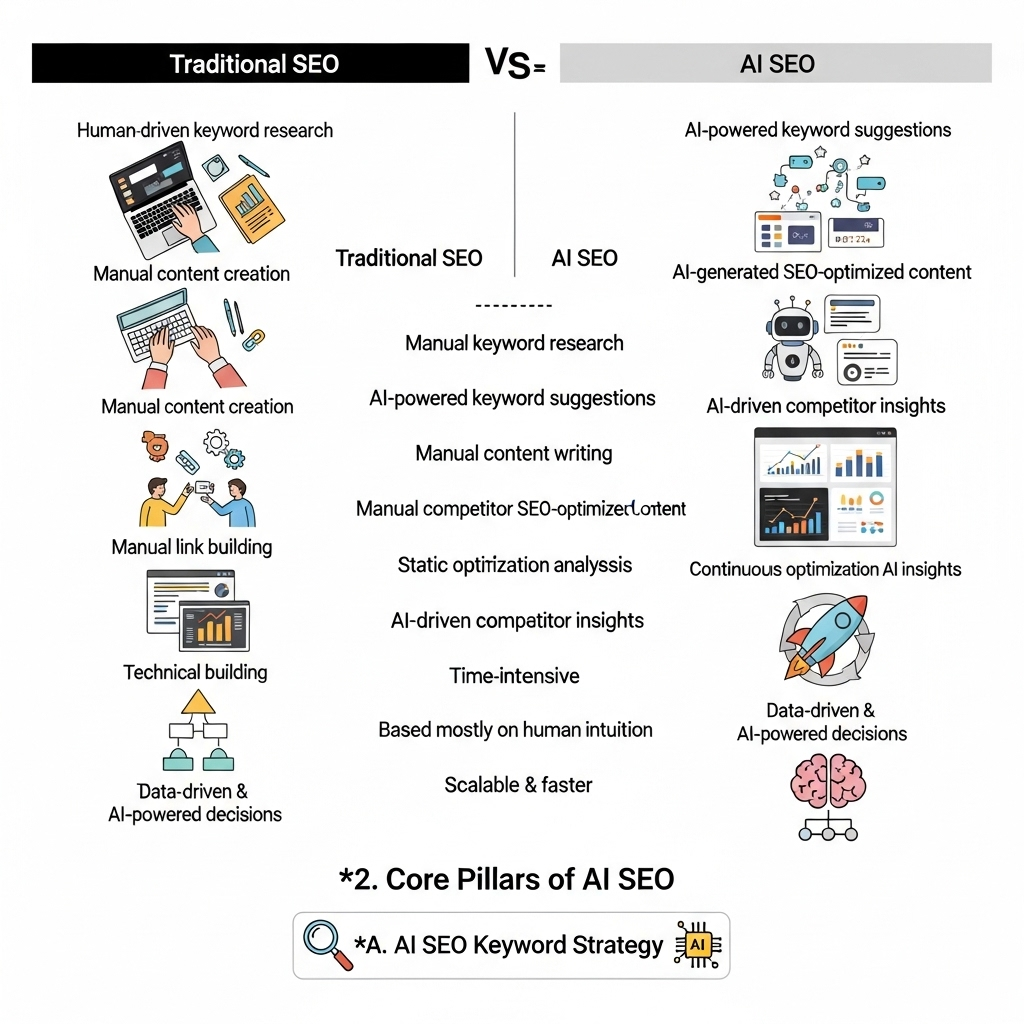
Here’s how you can implement SEO practices that deliver measurable results:
Step 1: Use AI for Keyword Research
Traditional keyword tools give you data. AI keyword tools give you intent.
Platforms like Surfer AI, Ahrefs, Semrush AI, RankIQ, and ChatGPT (with plugins) can help identify long-tail, low-competition keywords that align with what people actually mean — not just what they type.
✅ Pro tip: Use AI to find semantic clusters — related keyword groups that help your page rank for multiple variations.
Step 2: Create AI-Optimized Content
AI tools like Jasper, Writesonic, or ChatGPT help generate topic outlines, meta titles, and even full blog drafts. But don’t rely blindly — always add human insight and storytelling to make content authentic and credible.
Optimize for:
- EEAT (Experience, Expertise, Authoritativeness, Trustworthiness)
- Natural readability
- Contextual depth
AI helps you write faster, but your human voice ensures the content connects.
Step 3: Optimize On-Page SEO with AI
AI tools analyze your page in real-time to suggest:
- Keyword placement density
- LSI (Latent Semantic Indexing) terms
- Content structure improvements
- Internal linking opportunities
Tools like Frase.io or MarketMuse can even score your content’s topical authority compared to top-ranking competitors.
Step 4: Use AI for Technical SEO
AI crawlers and audit tools like Screaming Frog AI Edition or Sitebulb AI can detect:
- Crawl issues
- Mobile optimization gaps
- Page speed issues
- Broken links or schema errors
They not only detect but predict potential ranking risks before they impact traffic.
Step 5: Automate Analytics and Reporting
AI-based analytics platforms (e.g., Google Analytics 4 + AI Insights) help identify what’s working and what’s not — without manually digging into reports.
You get predictive traffic reports, ranking probability, and even AI-driven content recommendations.
3. Core AI SEO Elements You Must Master
Here are the essential SEO elements you need to understand and apply:
| AI SEO Element | Function | Example Tool/Approach |
|---|---|---|
| AI Keyword Intelligence | Predicts trending & semantic keywords | Surfer AI, RankIQ |
| Content Optimization AI | Enhances readability & keyword placement | Frase, Clearscope |
| AI Technical SEO Audit | Detects crawl, index, and performance issues | Sitebulb AI, Screaming Frog |
| Predictive SEO Analytics | Forecasts traffic & keyword shifts | Semrush Trends, GA4 AI |
| User Intent Analysis | Maps keywords to user behavior | ChatGPT, Google NLP |
| Voice Search Optimization | Adapts content for conversational queries | Google BERT/NLP Optimization |
| Automated Schema Markup | AI-generated rich snippets | RankMath AI, Schema App |
Mastering these SEO elements will give your website a competitive advantage in both ranking and content personalization.
4. Best Practices for AI SEO Success
To truly make SEO work, follow these proven best practices:
- Blend AI with human creativity — never publish auto-generated content without review.
- Update content regularly using AI-driven freshness signals.
- Track SERP changes and optimize for intent-based search (not just keywords).
- Use structured data and AI schema for rich results.
- Focus on user experience — AI measures engagement more than word count.
5. Trending Topics for AI SEO in 2025
If you want to create content or research around SEO, here are high-performing topics worth covering:
- How AI is changing Google Search ranking systems
- AI SEO tools comparison (Surfer AI vs Frase vs Jasper)
- Prompt engineering for SEO and content marketing
- AI-driven keyword clustering and topic authority
- Predictive SEO and the future of search personalization
- Voice Search & AI: How to optimize for conversational queries
- Using ChatGPT for on-page SEO optimization
- AI content detection vs human-authored content
- Automation in SEO reporting using AI dashboards
- Building topical maps and content clusters using AI
These topics not only attract organic traffic but also establish you as an SEO thought leader in your niche.
Conclusion
SEO isn’t about replacing SEO professionals — it’s about empowering them.
By integrating SEO practices and understanding the core elements of AI-based optimization, you can scale faster, target smarter, and stay ahead of the ever-changing Google algorithm curve.
If you’re ready to explore AI tools, automation, and strategies that simplify your SEO journey — start implementing these methods now. The future of SEO is intelligent, and those who adapt early will dominate search visibility.